
Student Village Academy › Forums › HISTORY › African History › History: The Fall of Derico Nwamama A Tale of Terror, Triumph, and Tragedy
- This topic has 0 replies, 1 voice, and was last updated 6 months, 4 weeks ago by
 Shola joshua.
-
AuthorPosts
-
-
August 30, 2025 at 11:09 AM #82851
 Shola joshuaModerator
The Fall of Derico Nwamama: A Tale of Terror, Triumph, and Tragedy in Nigeria
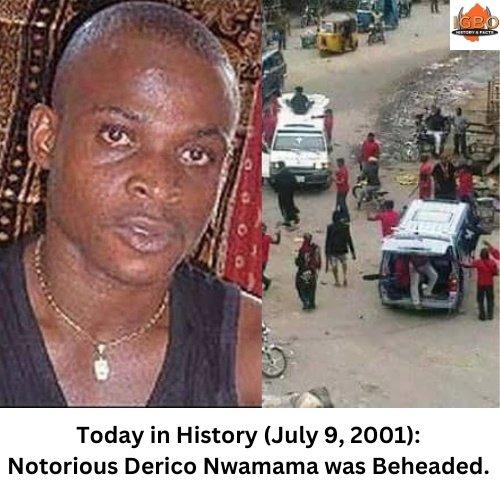
In the annals of Nigerian crime history, few names evoke as much dread and fascination as Derico Nwamama—real name Okwudili Ndiwe. His reign of terror over the South East from the late 1990s to the early 2000s ended abruptly in 2001, when he was beheaded at the tender age of 22. What began as the story of a street urchin spiraling into infamy morphed into a gripping saga of violence, resilience, and a dramatic public reckoning. Let’s journey through the rise and fall of this notorious figure, whose legacy still lingers in the shadows of Igboland.
From Streets to Slaughter: The Making of a Criminal
Derico’s tale starts humbly in the bustling streets of Onitsha, where he emerged as a scrappy pickpocket, honing his skills amid the chaos. But ambition and desperation soon transformed him into a full-fledged armed robber, a transition that catapulted him into the ranks of Nigeria’s most feared criminals. His name alone became a whisper of terror across Igboland, a symbol of lawlessness that chilled the spines of entire communities.His criminal ascent took a dark turn with the murder of his friend Chiejina, a fellow armed robber who once ruled Onitsha’s underworld. Their bond had forged during the infamous Umuleri-Aguleri crisis, a violent land dispute that shaped their early years. Though Derico resided in Abuja, he made frequent, calculated trips to the East, executing daring robbery missions before retreating with his spoils to enjoy a lavish life of power and comfort. His hideouts in Umuleri, Anambra State, and Agbor, Delta State, became launchpads for his operations, from which he taunted police with threatening letters after they killed his gang members.
A Reign of Ruthlessness
Derico’s criminal portfolio was as bold as it was brutal. He raided banks, amassed millions of naira, and left a trail of bodies in his wake. His gang’s signature move was targeting luxurious inter-state buses, turning journeys into nightmares.The pinnacle of his savagery came in December 2000, when he ambushed a 59-seater bus at Upper Iweka in Onitsha, en route to Lagos. After stripping the passengers of their belongings, he ordered their execution—only four survived to tell the tale. This act of unparalleled cruelty cemented his reputation as an untouchable menace.
At the time, Anambra State Governor Chinwoke Mbadinuju, nicknamed Odera, seemed powerless against Derico’s invisible reign. The police struggled to apprehend him, their efforts thwarted by his elusive nature and his unwavering belief in the mystical protection of native doctors, or dibia. He often boasted of his invincibility, declaring that no man born of a woman could end his life—a claim that only fueled his legend.
The Hunt Intensifies
By May 2001, the Anambra State Police Command launched “Operation Derico,” a desperate manhunt to capture the outlaw and dismantle his gang. They nabbed key members, including Amobi, his trusted motorcycle rider, but Derico slipped through their fingers, continuing his spree of robberies, murders, and kidnappings for ransom. Frustrated by the police’s failure, Governor Mbadinuju turned to an unconventional force: the Bakassi Boys, a sorcery-infused paramilitary group known for their ruthless efficiency.The tide turned in June 2001, when Derico escalated his audacity by attacking a police station to stockpile weapons for a planned bank heist in Asaba. He also forged alliances with other gangs, plotting even bolder strikes. But the net was closing. One morning, a joint operation by the Nigerian Police and Bakassi Boys raided his Abuja hideout. Though he escaped, two of his closest lieutenants fell, signaling the beginning of the end.
The Ambush and Capture
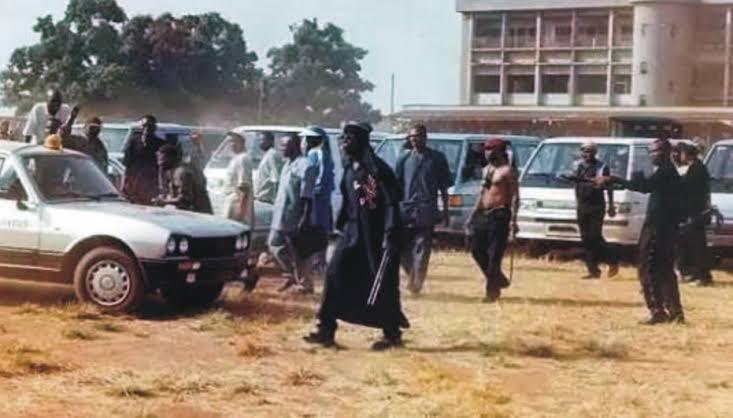
On the run, Derico adopted a nomadic existence, sensing the Bakassi Boys’ relentless pursuit. It was during one such journey that fate caught up. On Tuesday, July 3, 2001, the Bakassi Boys received a tip-off about his movement from Agbor to Onitsha. They set a cunning ambush at the iconic Head Bridge, spotting him aboard a bus. The arrest sparked wild celebrations across Onitsha, a city weary of his tyranny.The police requested custody for investigation and prosecution, but the Bakassi Boys, distrustful of the system, refused to hand him over. Six days later, on Monday, July 9, 2001, they paraded their prize in a dramatic convoy through Onitsha, culminating at Ọchanja Market near Upper Iweka Road. The crowd gathered, eager to see the “Big Meat”—Derico Nwamama—whose name had haunted their nights.
The Final Plea and Brutal End
Given a microphone, Derico faced the mob, his voice trembling with desperation. “My name is Oddy, also known as Derico Nwamama,” he began. “I appeal to you, Ndị Anambra, please don’t kill me. It’s true, I have killed many, but I will repent. I don’t like evil. It was when I killed Chiejina that people thought I was strong. I trust the Bakassi Boys—they are strong. Please, have mercy on me.” His pitiable plea fell on deaf ears.In a flash, a Bakassi Boy raised a cutlass, and with a single, merciless strike, Derico’s head was severed. The crowd roared in approval, their chants praising the vigilantes who had delivered justice. His body was dismembered and set ablaze, a public spectacle that marked one of Nigeria’s most harrowing executions. The event inspired films like Issakaba, Desperados, and the Igbo classic Ọkọchị, immortalizing his story on screen.
A Family’s Silent Legacy
Today, Derico’s mother thrives in her business, a testament to her resilience. He fathered a daughter who carries on, while his father, who passed at 70, was laid to rest in Onitsha on January 5, 2020. His siblings lead successful lives, leaving Derico as the family’s black sheep—a stark contrast to his once-mighty reputation.Derico Nwamama’s life was a whirlwind of crime, charisma, and chaos, ending in a moment that reshaped Anambra’s history. His story serves as a cautionary tale and a cultural touchstone, reminding us that even the most invincible can fall when justice—however brutal—catches up.
-
-
AuthorPosts
- You must be logged in to reply to this topic.