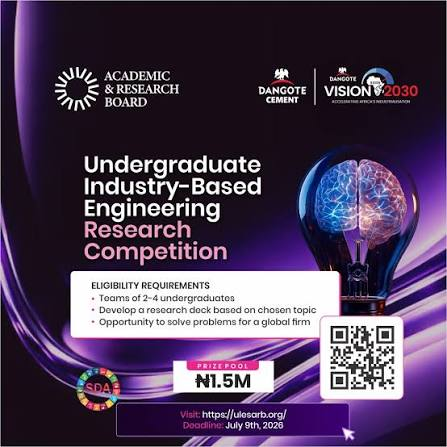
Dangote Cement Launches Undergraduate Engineering Research Competition; Dangote Cement Plc has announced the inaugural Industry-Based Engineering Research Competition for undergraduate engineering students in Nigeria.
The competition is organised by the Academic & Research Board (ARB) of the University of Lagos Engineering Society (ULES) and invites teams of undergraduate engineering students to develop practical, evidence-based solutions to real-life challenges in cement manufacturing.
Known as the DCP University Engineering Challenge, the competition provides participants with an opportunity to apply engineering knowledge to industry problems while proposing innovative and sustainable solutions.
About the Dangote Cement Undergraduate Engineering Competition
The Dangote Cement Plc Undergraduate Industry-Based Engineering Research Competition is an industry-focused challenge designed for university engineering students across Nigeria.
Participating teams will select one of four challenge tracks, analyse the identified problem, and develop an engineering and business case for a practical solution.
Sponsors and Organisers
The competition is sponsored by Dangote Cement Plc and organised by the Academic & Research Board (ARB) of the University of Lagos Engineering Society (ULES).
Why the Competition Focuses on Cement Manufacturing
The challenge is based on real operational issues affecting cement manufacturing.
Dangote Cement Plc operates manufacturing plants in Obajana, Ibese, Gboko, and Okpella, and the competition aims to bridge the gap between academic engineering research and practical industry needs by encouraging students to solve real plant-level challenges.
Eligibility Requirements
The competition is open to undergraduate students currently studying engineering in Nigerian universities.
To participate, teams must meet the following requirements:
- Team members must be currently enrolled university students studying an engineering discipline.
- Each team must consist of two to four members.
- Multidisciplinary engineering teams are encouraged.
- Each team must choose one of the four challenge tracks.
- All submissions must be original.
- Presenting another team’s work will result in disqualification.
Previous experience in the cement industry is not required, as each challenge brief provides the background information needed for participation.
Submission Requirements
Each participating team is expected to prepare an impactful research presentation based on its selected challenge track.
The final submission must include:
- A 10-slide executive presentation.
- A technical appendix or model/prototype, where applicable.
- A one-page business case outlining value, cost, assumptions, and risks.
- A simple implementation roadmap covering immediate, short-term, and medium-term actions.
- A risk and safety assessment relevant to the proposed solution.
- A statement of assumptions and data limitations.
Recommended 10-Slide Presentation Format
Teams are advised to structure their executive presentation as follows:
- Selected challenge and its importance to Dangote Cement Plc.
- Current-state problem diagnosis.
- Data insights, supporting exhibits, and key assumptions.
- Root-cause hypothesis.
- Proposed engineering and business solution.
- Technical feasibility and operating concept.
- Business case and expected impact.
- Risk, safety, sustainability, and mitigation plan.
- Roadmap and required resources.
- Final recommendation and pilot proposal.
Challenge Track 1: Alternative Fuel Sourcing and Pricing Optimisation
Problem Statement
Dangote Cement Plc is seeking ways to increase the use of alternative fuels in its cement kilns. However, sourcing, pricing, consistency, quality, logistics, and handling remain major challenges.
Teams are expected to identify feasible alternative fuel sources within Nigeria and develop a sourcing model capable of providing reliable, safe, and cost-effective fuel to selected cement plants.
Why This Matters
Alternative fuel contributes to:
- Improved thermal substitution rate (TSR).
- Better fuel cost management.
- Sustainability.
- Circular economy initiatives.
- Reduction of carbon dioxide (CO₂) emissions.
This challenge is particularly relevant where TSR falls below target or fuel supply and pricing limit kiln substitution.
Expected Deliverables
Teams should provide:
- An alternative fuel opportunity map by location and fuel type.
- Cost-per-ton and basic energy-value comparison.
- Recommended top three alternative fuel options with supporting justification.
- Pilot implementation roadmap, risk register, and mitigation plan.
- Business case demonstrating expected value to Dangote Cement Plc.
Recommended disciplines include:
- Chemical Engineering.
- Mechanical Engineering.
- Civil and Environmental Engineering.
- Other related engineering fields.
Challenge Track 2: Predictive Maintenance and Reliability Early-Warning System
Problem Statement
Dangote Cement plants rely on several critical systems, including crushers, raw mills, coal mills, kilns, cement mills, and packing equipment.
Unexpected equipment failures reduce reliability, productivity, and operational efficiency. Teams are expected to develop an early-warning system capable of identifying high-risk equipment before major failures occur.
Why This Matters
A practical predictive maintenance system will help maintenance and operations teams:
- Prioritise inspections.
- Reduce repeated failures.
- Improve root-cause analysis.
- Protect production output.
Expected Deliverables
Teams should submit:
- Reliability early-warning framework.
- Risk-scoring model with clearly stated assumptions.
- Dashboard mock-up or prototype.
- Sample maintenance escalation workflow.
- Plant implementation roadmap.
Recommended disciplines include:
- Mechanical Engineering.
- Electrical Engineering.
- Mechatronics.
- Computer Engineering.
- Other related disciplines.
Challenge Track 3: Cement Production Conversion Gap
Problem Statement
A cement plant may produce enough clinker but still fail to achieve expected cement production targets.
Teams are required to investigate why clinker production does not always translate into cement output and develop a conversion-loss framework that identifies constraints relating to production rate, runtime, feed, additives, packing, dispatch, and planning.
Why This Matters
Cement production depends on more than kiln performance.
Key factors include:
- Mill availability.
- Grinding rate.
- Product mix.
- Additive availability.
- Silo capacity.
- Packing capacity.
- Dispatch readiness.
- Power availability.
- Production planning.
Expected Deliverables
Teams should provide:
- Clinker-to-cement conversion framework.
- Loss tree or loss-bridge template.
- Dashboard mock-up for daily plant monitoring.
- Root-cause hypotheses for common conversion losses.
- Action plan assigning responsibilities by system.
Recommended disciplines include:
- Mechanical Engineering.
- Chemical Engineering.
- Other relevant engineering disciplines.
Challenge Track 4: Digital KPI Automation and Data Quality
Problem Statement
Dangote Cement Plc relies on accurate daily, monthly, and year-to-date KPI reporting across its plants.
Manual reporting often leads to delays, inconsistent reporting formats, missing information, and poor traceability. Teams are expected to develop a digital KPI reporting and validation system that improves reporting quality and management decision-making.
Why This Matters
Accurate performance data supports continuous operational improvement.
This challenge aims to deliver:
- Faster reporting.
- Stronger governance.
- Fewer manual errors.
- Standardised KPI definitions.
- Better visibility across the Obajana, Ibese, Gboko, and Okpella plants.
Expected Deliverables
Teams should submit:
- KPI data model and reporting workflow.
- Validation rule library.
- Exception dashboard or wireframe.
- Plant sign-off and escalation process.
- Implementation roadmap using Excel, Power BI, Power Apps, Python, or other suitable tools.
Recommended disciplines include:
- Computer Engineering.
- Systems Engineering.
- Electrical/Electronic Engineering.
- Other related engineering fields.
Competition Prizes
The top-performing teams will receive cash prizes and certificates at the end of the competition.
The total prize pool is ₦1,500,000, distributed as follows:
- 1st Place: ₦700,000 and a certificate.
- 2nd Place: ₦500,000 and a certificate.
- 3rd Place: ₦300,000 and a certificate.
The organising team will confirm the prize details before the final pitch presentation.
How to Register
Interested teams are required to register through the official DCP University Engineering Challenge registration portal.
During registration, each team must indicate its preferred challenge track.
Registration Deadline
Registration closes on 16 July 2026.
Late applications will not be accepted. Eligible teams are encouraged to complete their registration before the deadline.
What Teams Should Prepare Before Registering
Before completing the registration process, teams should:
- Confirm all team members.
- Select one of the four challenge tracks.
- Agree on the proposed research direction.
- Ensure that all submitted work is original.
Teams should note that presenting another team’s work is grounds for immediate disqualification.